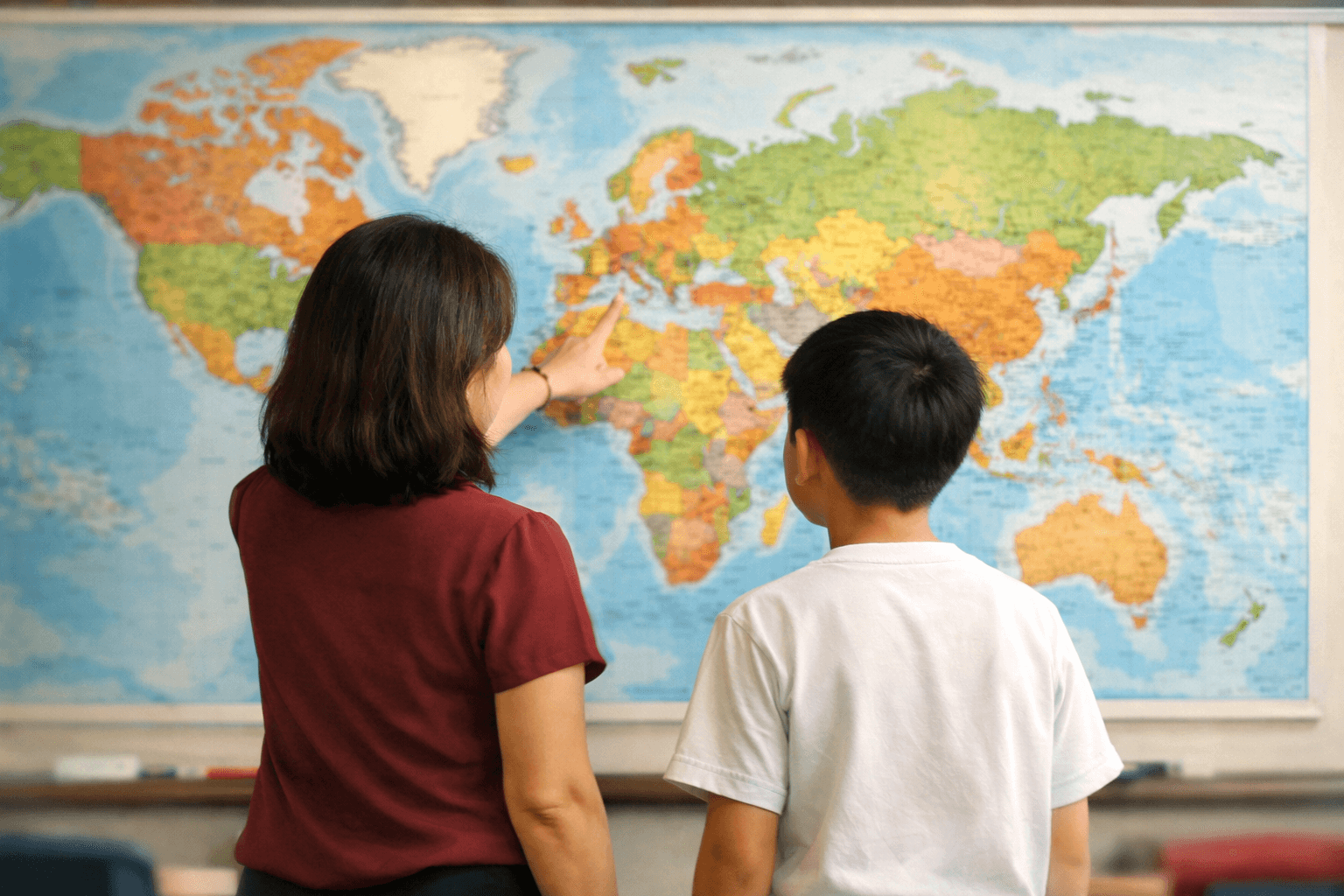
Lower Secondary Humanities
(Secondary 1 & 2)
- History
- Geography
The lower secondary Humanities tuition is organised into two parts: the Secondary One and Secondary Two Programmes. Each level will cover History and Geography, where relevant. The main aim is to develop a broader level of interest in the field of Humanities.
What Your Child Will Learn
Thematic Study: Explore various topics for History and Geography through class discussions.
Development of critical thinking skills: Using various topics as context, attempt various class practices to make sense of the History and Geography-related topics.
Our Approach
Organised study notes to consolidate the key areas of learning for each topic.
Tutor guidance given to students to learn how to read, analyse and write well.
Small class size to ensure an optimal learning environment.
Secondary 1
For Secondary One Geography, students will examine the following:
Unit 1: Water
Unit 2: Tropical Rainforest and Mangroves
For Secondary One History, students will examine the following:
Unit 1: From Temasek to Singapore (1299-Early 1800s)
Unit 2: Singapore’s Development as a Port City under the British (1819-1942)
What Your Child Will Learn
The Secondary One Geography programme explores the importance of natural resources, namely water, tropical rainforests and mangroves:
In Unit 1, students have to make sense of the concepts of ‘renewable’ and ‘non-renewable’ resources as well as the value of water in the geographical context.
In Unit 2, students explore the characteristics of tropical rainforests and mangroves, as well as the impacts of man-made activities on the natural environment.
The Secondary One History programme examines the following:
In Unit 1, students explore the historical context of early Singapore between the 1300s and early 1800s as it becomes a notable trading post under the British.
In Unit 2, students are to examine the impacts of British colonial rule on Singapore as well as the impacts of World War Two.
Class activities will include the following:
Geographical Investigation - Learn to make sense of unseen data given in the context of Geography to form logical trends and apply relevant concepts to data-related and extended questions.
Quizzes and Mock Tests - To gauge knowledge proficiency following the study of various Geography-related content.
Source-Based Case Study Practices - Learn to read and analyse unseen source-based content in illustrative and text forms to apply relevant skills (inference and comparison).
Secondary 2
For Secondary Two Geography, students will examine the following:
Unit 3: Housing
Unit 4: Transport Systems
For Secondary Two History, students will examine the following:
Unit 3: Singapore’s Struggle for Independence (1942-1965)
Unit 4: Surviving as an Independent Nation-State (1965-Late 1970s)
What Your Child Will Learn
The Secondary Two Geography programme explores the following:
In Unit 3, students learn to develop an appreciation of diverse people living in common areas as well as the impacts of housing on societies.
In Unit 4, students examine various transport systems that enable the movement of people, goods and services in cities.
The Secondary Two History programme explores the following:
In Unit 3, students will learn more about the consequences of the Japanese Occupation on the people in Singapore, followed by the path towards self-government as well as the significance of Merger and the Separation.
In Unit 4, students will learn more about various challenges that threaten national security, the importance of a national defense force as well as the need for Singapore’s survival.
Class activities will include the following:
Geographical Investigation - Learn to make sense of unseen data given in the context of Geography to form logical trends and apply relevant concepts to data-related and extended questions.
Quizzes and Mock Tests - To gauge knowledge proficiency following the study of various Geography-related content.
Source-Based Case Study Practices - Learn to read and analyse unseen source-based content in illustrative and text forms to apply relevant skills (inference and comparison).
Content Consolidation - A broad coverage of what has been covered in the earlier sections to make sense of the various topics taught as well as a review of the reading and writing skills for Geography and History.


testimonials